 daa34fbc38
## Summary

Eliminates the remaining backend/PostgreSQL-mode sync-SQLite
(`store.db`) call sites — both the crashing ones and the
try/catch-masked ones that silently degraded features. Found via a full
audit of `store.db`/`archiveDb` residue after the PG cutover's per-site
routing missed them.

**Crashes fixed:**
1. **refineTask / duplicateTask** threw `TaskStore.db: SQLite Database
is not available in backend mode`. Both create rows through
`createTaskWithId` callbacks calling `store.atomicCreateTaskJson()`
directly, bypassing `_createTaskInternal`'s backend routing. The shared
helper now routes itself (soft-delete conflict check + non-destructive
insert in one AsyncDataLayer transaction).
2. **Merger verification cache**: `getVerificationCacheHit` ran sync
SQLite unguarded *outside* any try/catch in
`runDeterministicVerification`; `recordVerificationCachePass` was
swallowed so the cache never warmed. Both are now async with a PG
branch.

**Silent degradations fixed (features that were dead on PG):**
- Workflow run-branch + foreach step-instance persistence
(`saveWorkflowRunBranch`, `loadWorkflowRunBranches`,
`clearWorkflowRunBranches`, `saveWorkflowRunStepInstance`,
`loadWorkflowRunStepInstances`, `clearWorkflowRunStepInstances`) —
executor crash-resume checkpoints were silently never persisted.
- `getBranchProgressByTask` — returned an empty map, dropping
`branchProgress` from task payloads.
- `runPluginColumnTransitionHooks` — plugin `onEnter`/`onExit`
column-transition hooks never fired (marker bookkeeping + non-locking
task read now async).
- `getTaskColumns` — dashboard treated all agent-linked tasks as
non-terminal.
- `getWorkflowStep` / `listWorkflowSteps` — stored workflow-step rows
now read from `project.workflow_steps` (listing previously returned
plugin steps only); `getLegacyWorkflowStepSnapshot` returns `undefined`
on PG (legacy snapshot exists only in pre-migration SQLite).
- `readRawProjectSettings` / `listWorkflowPromptOverridesForProject` —
now read via the async layer.

These store methods became **async**; engine/dashboard callers await
them (the workflow persistence interfaces already accepted
`Promise`-returning impls).

**PG gotcha encoded in the fixes:** migration `0006_project_ownership`
rebuilds every project-schema PK to lead with `project_id`, so
column-list `ON CONFLICT` inference fails (42P10) — upserts target the
PK by constraint name.

## Surface Enumeration

- Creators through `atomicCreateTaskJson`: `refineTaskImpl`,
`duplicateTaskImpl` (fixed); `_createTaskInternalImpl` unaffected
(already routed).
- Verification-cache callers (all merger, all 3 sites now awaited).
- Run-branch/step-instance callers: executor persistence adapters,
parse-steps foreach probe, integration-queue flip, crash-resume
reconcile, graph-reset cleanup; triage replan cleanup; dashboard
spec-rebuild pin clears; agent-reflection rework summing — all awaited.
- Audit classified everything else as guarded or sync-mode-only (dead in
production — every entry point constructs stores via
`createTaskStoreForBackend`).

## Symptom Verification

- **Original symptoms:** refinement/duplicate creation threw; merge
verification threw; workflow checkpoints/branch progress/plugin
hooks/task-column lookups silently no-oped on PostgreSQL.
- **Exact reproduction:** `refine-duplicate-task.pg.test.ts`,
`verification-cache.pg.test.ts`, and
`sync-db-residue-backend.pg.test.ts` exercise each surface against
embedded-PostgreSQL backend-mode TaskStores.
- **Assertion it is gone:** all suites pass (14 + 5 tests), plus
`transition-pending-and-status-clear.pg.test.ts`,
`create-task-reserved-id.pg.test.ts`, dashboard `routes-github.test.ts`
(123), engine `triage.test.ts` (221) and `agent-reflection.test.ts`
(31). Core/engine/dashboard typecheck fully clean: the 13 errors from
the FN-8142 pi SDK migration are fixed by bumping
@earendil-works/pi-ai/pi-coding-agent to ^0.80.10 (FN-8142 used APIs
absent from the previously locked 0.80.6). Locally green: `pnpm
verify:fast` (scoped typecheck + build + CLI build + boot smoke), `pnpm
test:gate`, and `pnpm lint`.

🤖 Generated with [Claude Code](https://claude.com/claude-code)

<!-- This is an auto-generated comment: release notes by coderabbit.ai
-->
## Summary by CodeRabbit

* **Bug Fixes**
* Fixed refinement/duplication task creation in PostgreSQL-backed
backend mode.
* Improved backend-mode persistence for workflow checkpoints,
foreach-step instances, branch progress, and cleanup flows (including
retries/resets/transitions), so stored data reliably round-trips.
* Hardened backend-mode reads for workflow steps, task columns, project
settings, and prompt overrides.
* Made verification-cache reads/writes complete reliably, including
command-specific cache behavior.
* **Tests**
* Added PostgreSQL integration/regression coverage for
refinement/duplication, sync residue, and verification caching.
* **Chores**
* Bumped `@earendil-works/pi-ai` and `@earendil-works/pi-coding-agent`
to `^0.80.10`.
<!-- end of auto-generated comment: release notes by coderabbit.ai -->

---------

Co-authored-by: Claude Fable 5 <noreply@anthropic.com>

@runfusion/fusion
From rough idea to production code — automatically.
Multi-node agent orchestrator — tasks, agents, missions, git, files, and worktrees, with any model, local or cloud.
runfusion.ai → · GitHub · Docs

Install
Zero install, straight from npm:
npx runfusion.ai
Boots the dashboard. Subcommands forward through (npx runfusion.ai task list, etc). Long form: npx @runfusion/fusion dashboard.
One-line installer (macOS & Linux — auto-picks Homebrew, falls back to npm):
curl -fsSL https://runfusion.ai/install.sh | sh
Homebrew (macOS & Linux):
brew install runfusion/fusion/fusion
Fully-qualified install auto-taps and, on Homebrew 6.0+, trusts only this formula. If short-name install fails with “untrusted tap”, run brew trust --formula runfusion/fusion/fusion then brew install fusion.
npm global:
npm install -g @runfusion/fusion
fn dashboard              # or: fusion dashboard
Launch the dashboard
From a shell:
fn dashboard                 # or: fusion dashboard / npx @runfusion/fusion dashboard
fn dashboard --paused        # start with automation paused
fn dashboard --dev           # development-mode dashboard + AI engine
fn dashboard --no-engine     # web UI only, no AI engine
The dashboard gives you:
- A live kanban board — tasks move through columns automatically as AI works on them
- Task detail view — generated spec, step-by-step progress, reviewer verdicts, full execution log
- Dependency-aware scheduling — declare task dependencies or let the engine infer them
- Auto-merge — on by default; reviewed work squash-merges without you lifting a finger
- Parallel execution — independent tasks run simultaneously in isolated git worktrees
- Self-sustaining board — agents may spawn follow-up tasks; the board feeds itself
Your entire dev environment. On a single pane of glass.
Describe a task in plain language. A triage agent reads your project, understands context, and writes a full PROMPT.md spec — steps, file scope, acceptance criteria. Then Fusion plans, reviews, executes, and reviews again, in an isolated git worktree, with a human approval gate wherever you want one.
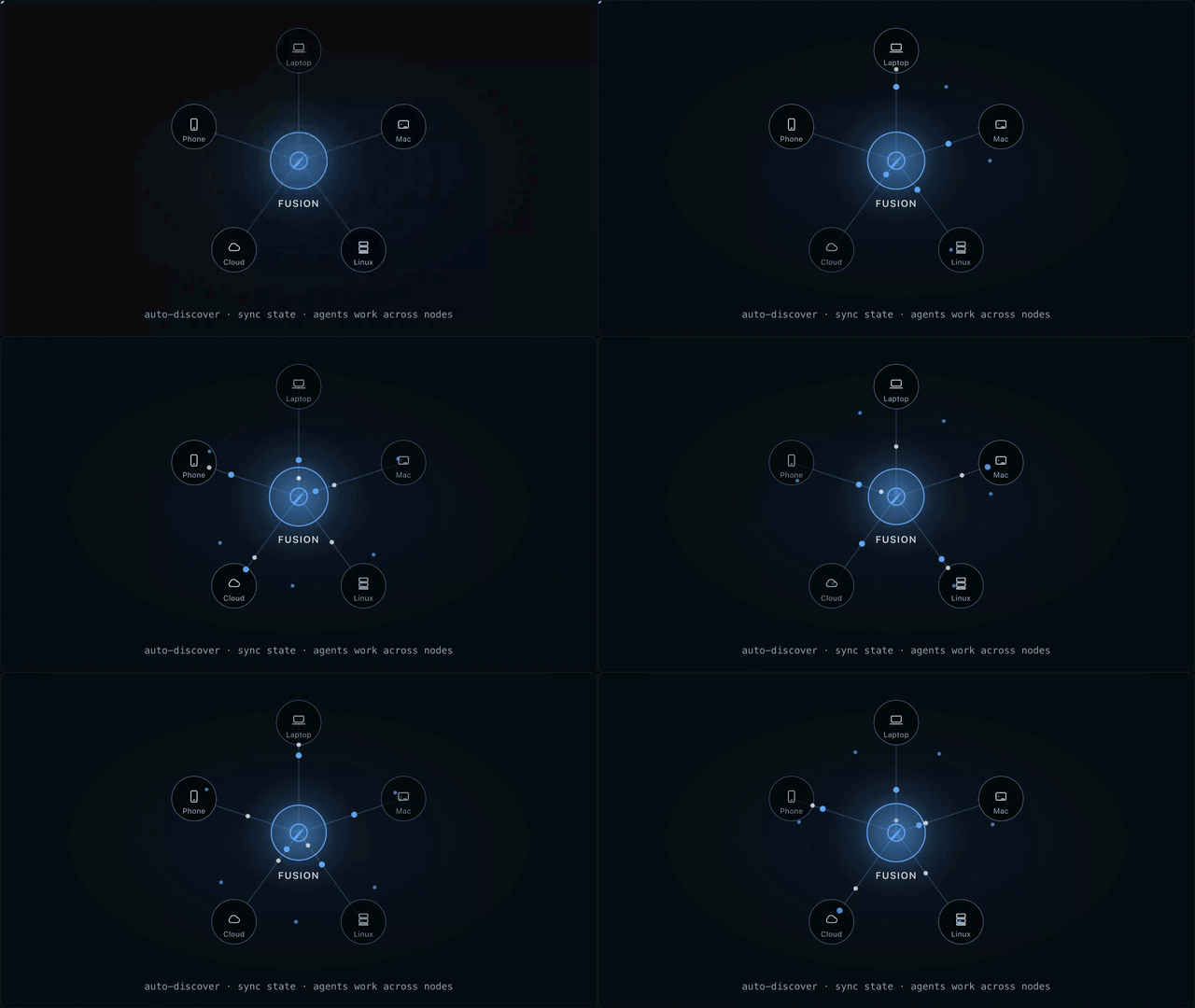
One board. Controlled from anywhere. Laptop, Mac mini, Linux server, cloud VM, phone — all connected.
Run an agent company
Import a team. Run it autonomously for weeks. 440+ agents across 16 companies, wired for missions, mailboxes, and inter-agent delegation.
npx companies.sh add paperclipai/companies/gstack

How it works
You create a task with a rough description. A pipeline of specialized agents takes over.
Specification. A triage agent reads your codebase — file structure, existing patterns, related code — and turns your rough idea into a detailed spec. It breaks the work into discrete steps, identifies which files are in scope, writes acceptance criteria, and assigns a complexity rating that determines how aggressively the work gets reviewed.
Scheduling. Tasks declare dependencies on each other. The scheduler builds a dependency graph and starts work only when upstream tasks are done. Independent tasks run in parallel — each in its own isolated git worktree, so there are no conflicts during execution.
Execution & review. An executor agent works through the spec step by step in the worktree. At each step boundary, a separate reviewer agent, with read-only access, independently evaluates the work. The reviewer can approve (continue), request revisions (fix specific issues), or force a rethink (change the approach entirely). Review depth scales with the task's complexity rating: trivial tasks get light checks, complex tasks get thorough multi-pass review.
Merge. When execution finishes and the reviewer signs off, the task moves to In Review:
- Direct merge (default) — automatically squash-merges the completed task branch into your current branch with a clean commit.
- Pull request — automatically creates or links a GitHub PR, waits for reviews/checks, then merges once policy conditions are satisfied.
autoMerge controls whether Fusion performs completion automatically. If disabled, tasks stay in In Review until you finish the merge yourself. For PR-first mode, authenticate GitHub with gh auth login.
Tasks flow through: Triage → Todo → In Progress → In Review → Done.
This execution model is heavily based on Taskplane.
What makes it different
| 🧠 AI specification | Rough idea in, detailed PROMPT.md out — steps, file scope, acceptance criteria. |
| 🔁 Workflow gates | Plan → Review → Execute → Review on every step. Block or pass automatically. |
| 🌳 Worktree isolation | Each task runs in its own branch and worktree. Parallel tasks. Zero conflicts. |
| ⚡ Smart merge | Passing every gate? Fusion squash-merges and moves on. |
| 🛰️ Multi-node mesh | Laptop, server, cloud, phone — all synced. Desktop, mobile, web. |
| 🧩 Any model | Anthropic, OpenAI, Ollama, and more. |
| 🏢 Agent companies | Import pre-built teams — 440+ agents across 16 companies. |
| 📬 Inter-agent messaging | Built-in mailbox between agents. Delegate, clarify, coordinate. |
| 🗺️ Missions | Hierarchical planning with autopilot and validation contracts. |
| 🔓 Open source. MIT. | No vendor lock-in. Run it on your own hardware. |
Working from chat
Manage tasks without leaving the conversation:
"Every ten minutes, analyze the server code for logic the client hasn't implemented yet and create tasks. Tasks may spawn additional tasks, so just add enough to keep the board saturated."
"Create a Fusion task to fix the login redirect bug"
"Add a task for dark mode support, it depends on FN-003"
"What's the status of FN-042"
"Attach screenshot.png to FN-007"
"Pause FN-012 — I want to add more context first"
The Fusion extension exposes tools to create tasks, check progress, attach files, and pause or resume automation.
Standalone CLI
See STANDALONE.md for additional installation and usage options.
Optional provider: Factory AI via Droid CLI
@runfusion/fusion now ships a vendored @fusion/droid-cli extension in the published CLI bundle.
To use it:
- Install the
droidbinary and ensure it is on yourPATH - Authenticate with Droid CLI (
droid auth login) - In Fusion dashboard, go to Settings → Authentication and enable Factory AI — via Droid CLI
- Restart Fusion when prompted so the extension is loaded into the runtime
Once enabled, droid-cli models appear in Fusion model selection.
Maintainer note: workspace plugins in published CLI bundles
When CLI or dashboard runtime code imports workspace plugin packages (for example @fusion-plugin-examples/roadmap), those imports must stay statically analyzable and covered by packages/cli/tsup.config.ts noExternal rules so plugin runtime code is inlined into dist/bin.js.
Do not introduce dynamic or variable module specifiers for workspace plugin runtime paths in the published execution path. If a workspace plugin is needed for bundled auto-install, stage a bundled plugin entry (dist/plugins/<id>/bundled.js) rather than copying raw TypeScript source into dist/.
Full documentation
Architecture details, development setup, and contributor info live in the project README.
License
MIT — see LICENSE.