 55745af80f
Settings had three compounding problems: you couldn't find a setting, and once you found it, it didn't look like its neighbour. ## Organization — the nav was grouped by the wrong thing It was grouped by **scope** (Global / Runtimes / Project). Scope is an *attribute* of a setting, not a category — nobody opens Settings thinking "I need a project-authority setting." That single choice split five concepts across two groups, including **two nav entries both labelled "MCP Servers"**, distinguishable only by a small icon. Now grouped by topic, with paired sections adjacent and stating their own scope: 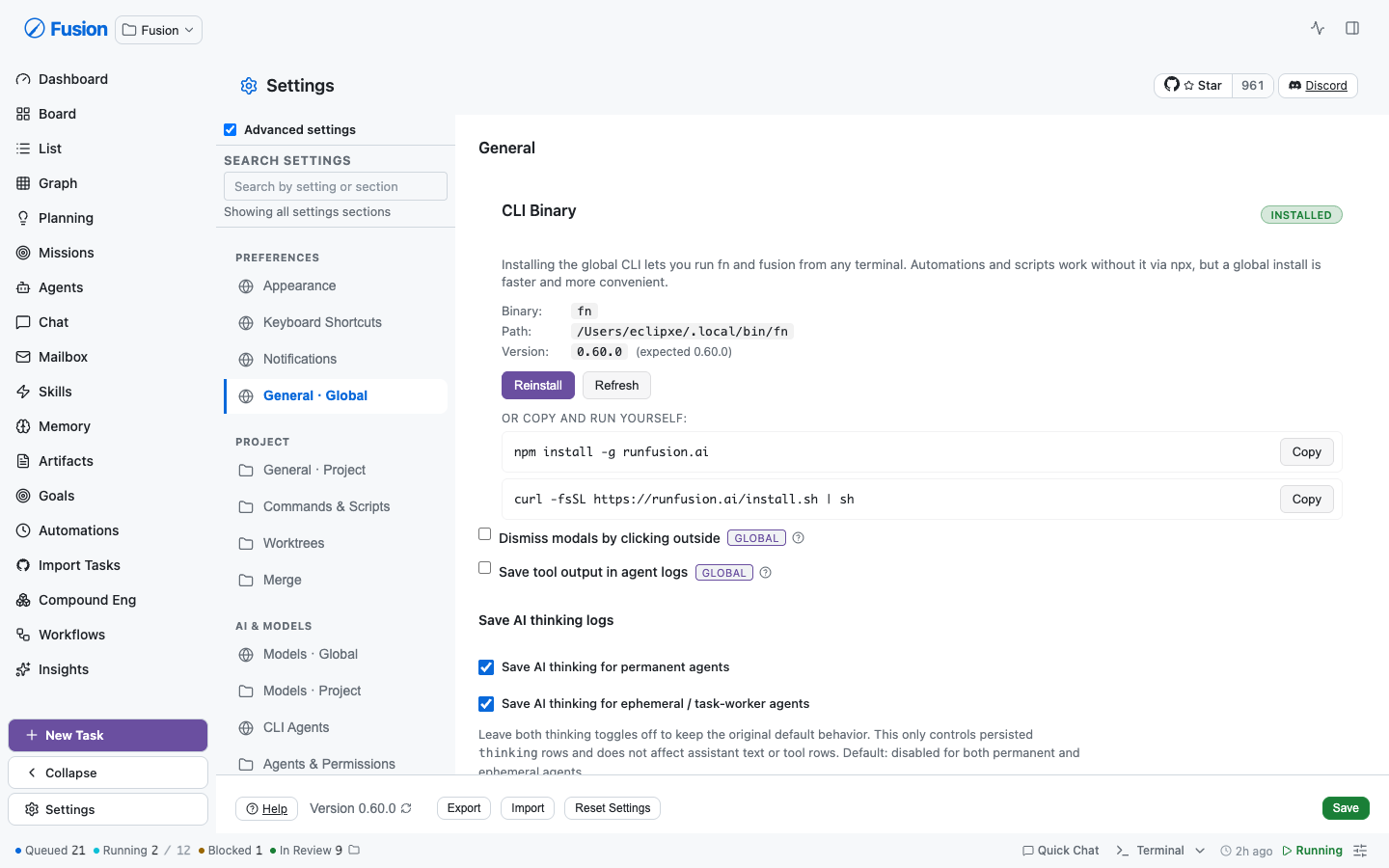 ``` PREFERENCES Appearance · Keyboard Shortcuts · Notifications · General · Global PROJECT General · Project · Commands & Scripts · Worktrees · Merge AI & MODELS Models · Global · Models · Project · CLI Agents · Agents & Permissions · Prompts · Memory AUTOMATION Scheduling & Capacity · Scheduled Evals INTEGRATIONS Authentication · MCP Servers · Global · MCP Servers · Project · Plugins · Runtimes · Secrets INFRASTRUCTURE Node Sync · Node Routing · Remote Access · Backups ADVANCED Experimental Features ``` ## Search — it now finds settings, not just sections Search matched only hand-written `searchableText` keyword arrays per nav entry, and those demonstrably rotted: Project Models accumulated 20 keywords across **two separate fixes** (FN-7907, then title-summarization on 2026-07-14) because operators searched "summarize" and got nothing. Every setting is now indexed from **its real label and help text** — 123 settings across 18 sections, zero curated keywords. The same query that was patched twice by hand: 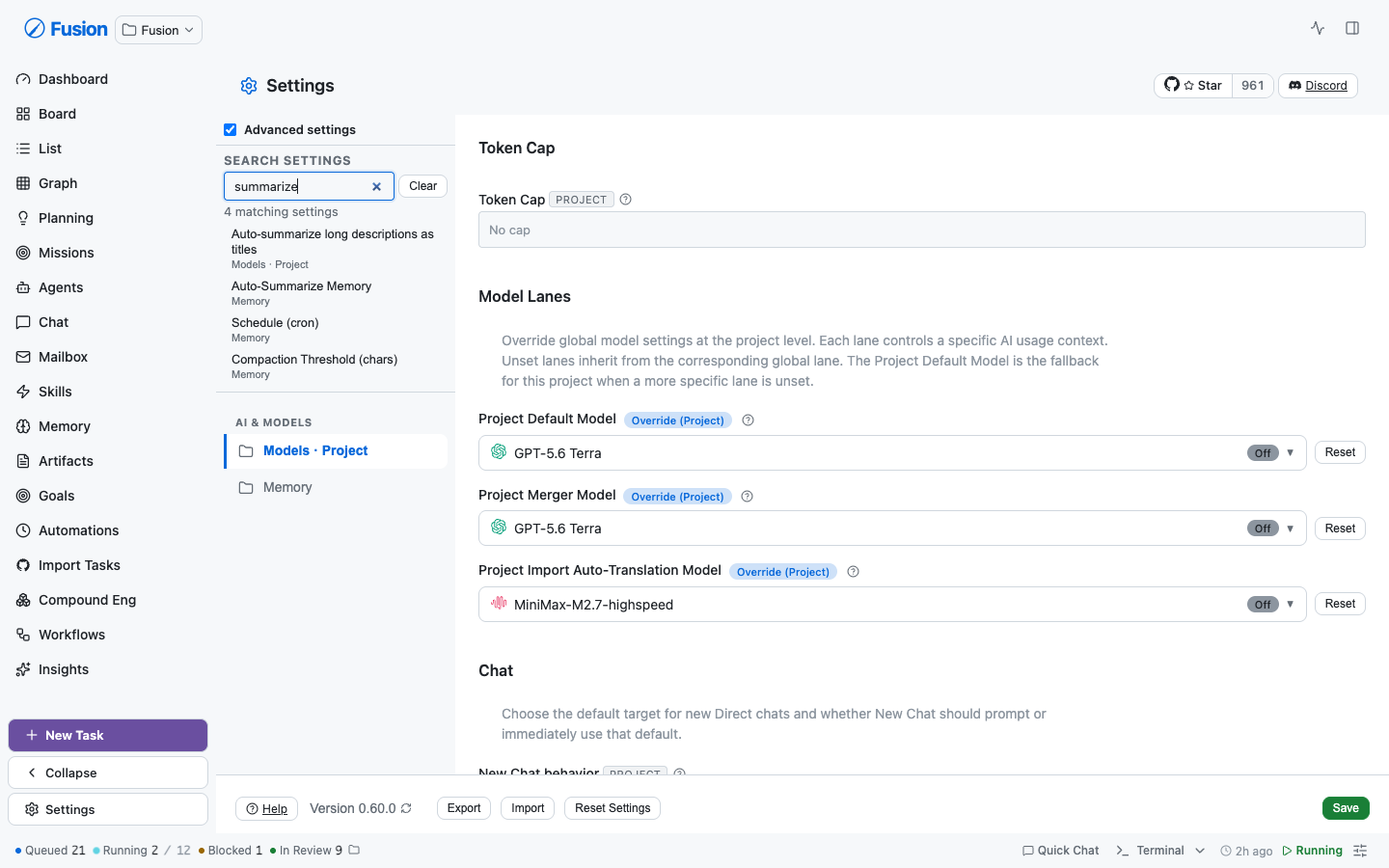 Two of those four hits match on *help text*, which a keyword index structurally cannot do. Picking a result jumps to the exact control, **opens its collapsed disclosure**, and highlights it: 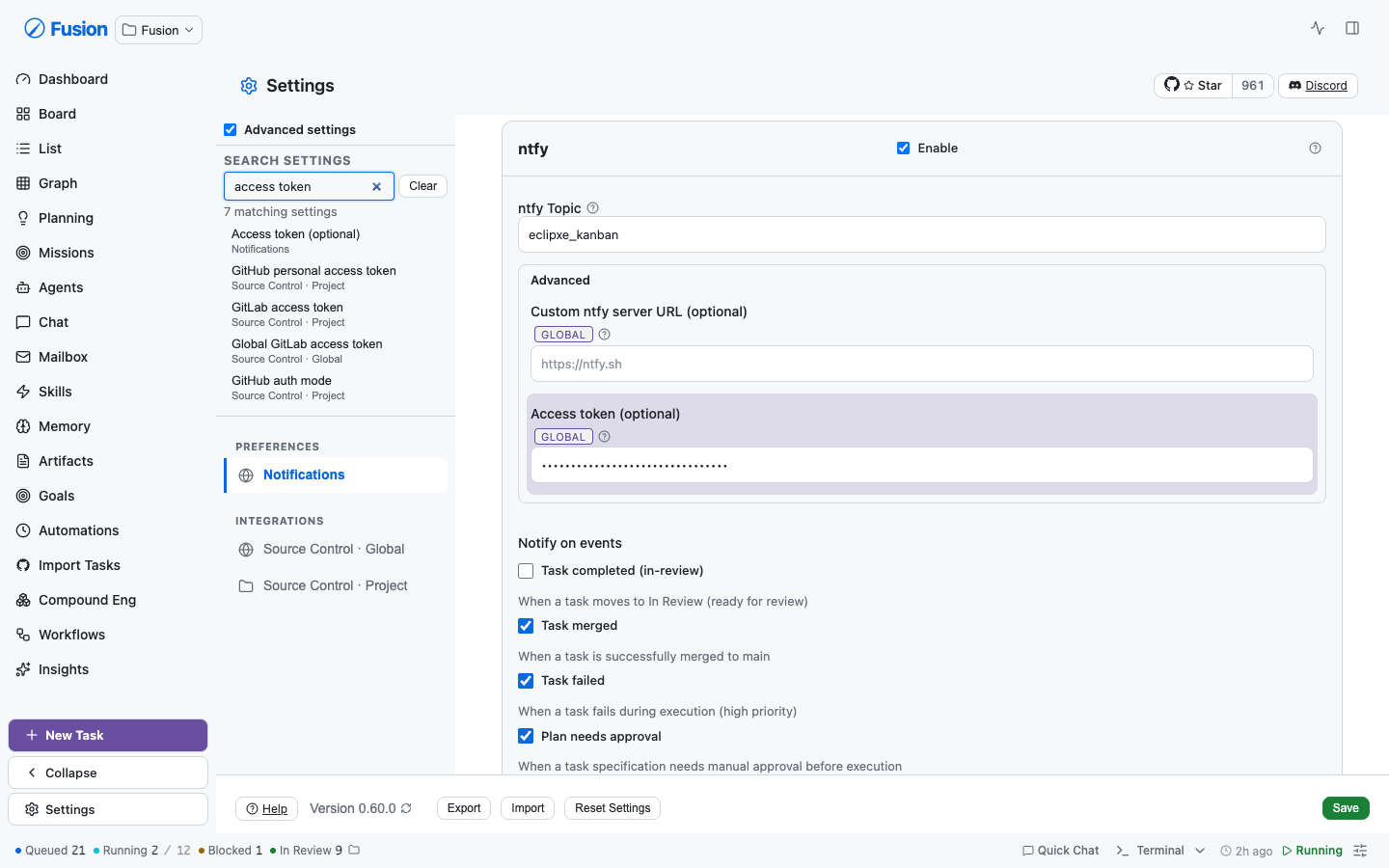 **This can't rot again.** `settings-search-index.test.ts` extracts every `descriptor={{ key }}` from section sources and fails the build if one isn't indexed. "All settings are searchable" is an enforced invariant, not a promise. ## Consistency — one type scale A text field's label and a toggle's label in the same section were styled **three different ways**: `.form-group label` (12px/600/uppercase/muted), a `.settings-content` override narrowing it to 0.72rem, and `.checkbox-label` (13px/500/sentence-case) whose every declaration carried `!important` purely to out-specify the other two. | | Before | After | |---|---|---| | Sections on shared primitives | 1 | **18** | | Indexed searchable settings | 0 | **123** | | `form-group` in settings | 226 | **98** | | `checkbox-label` in settings | 79 | **40** | 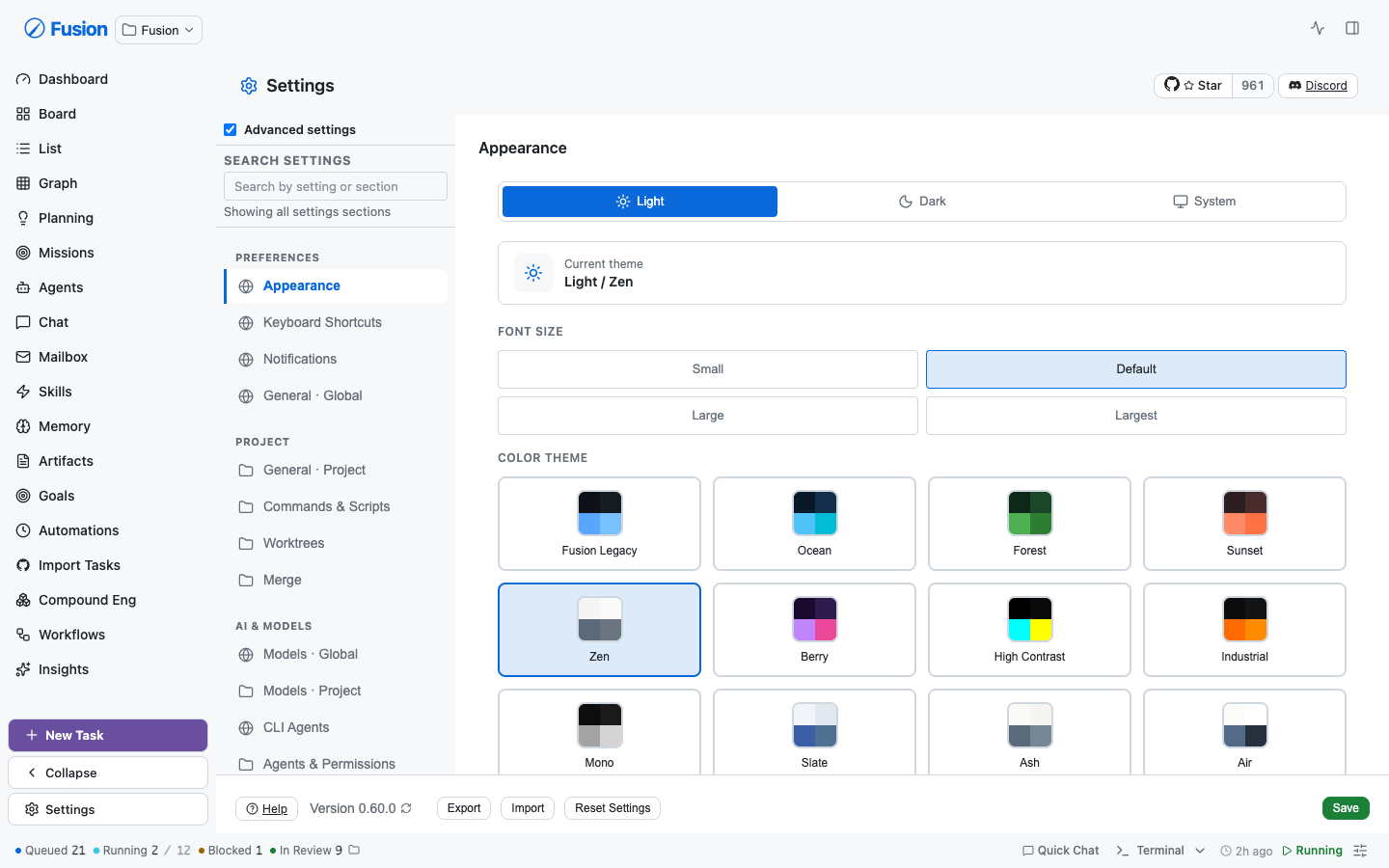 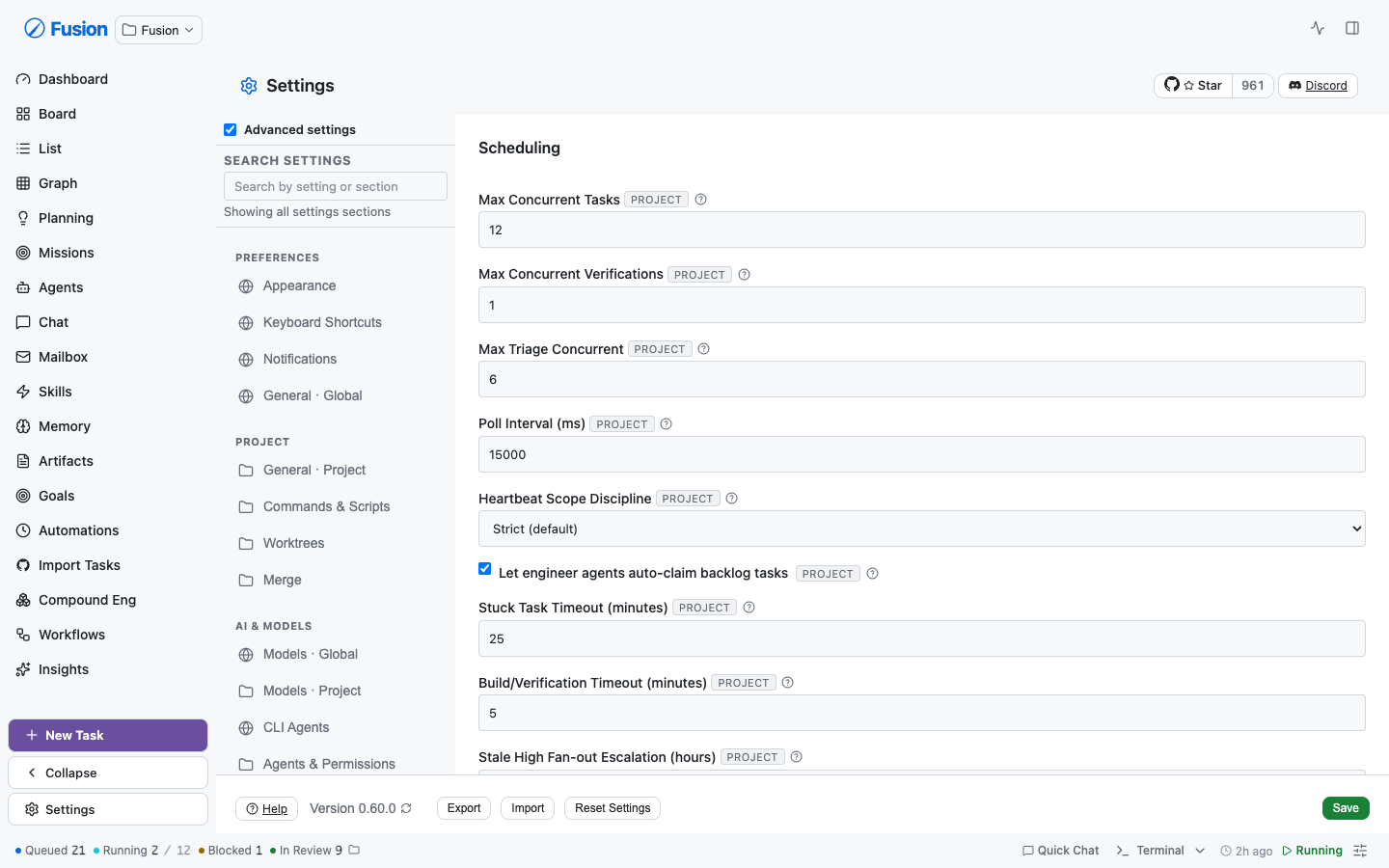 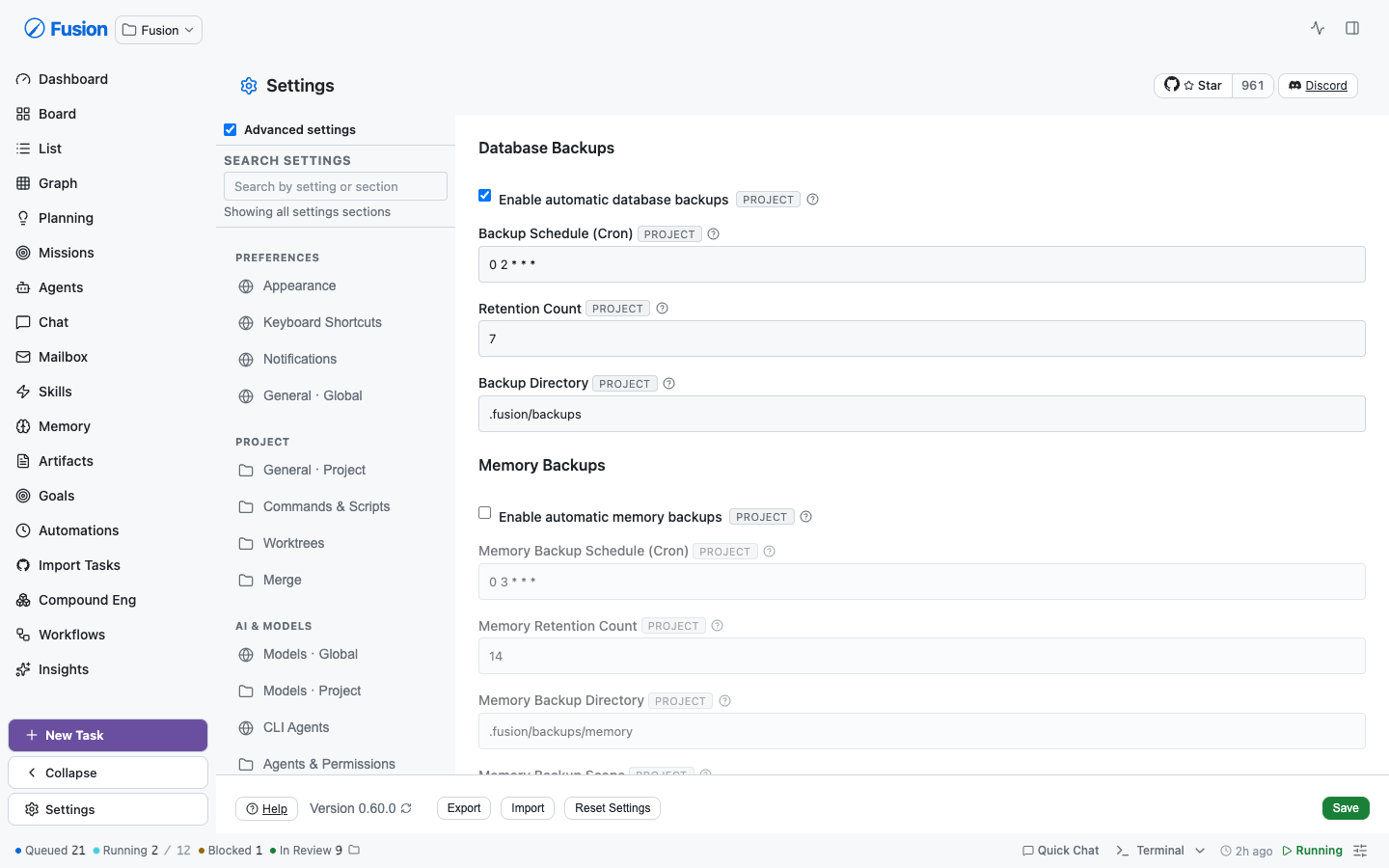 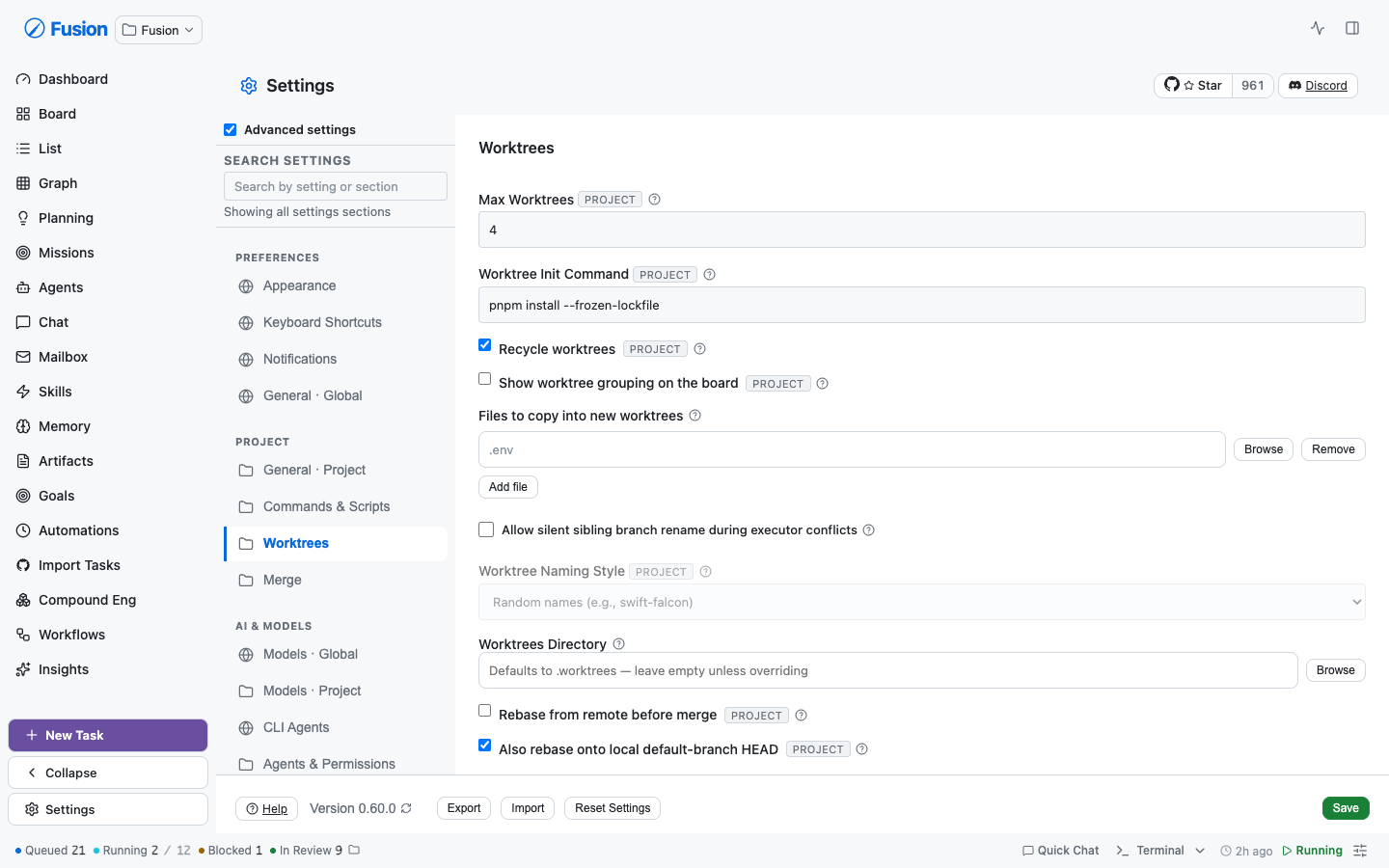 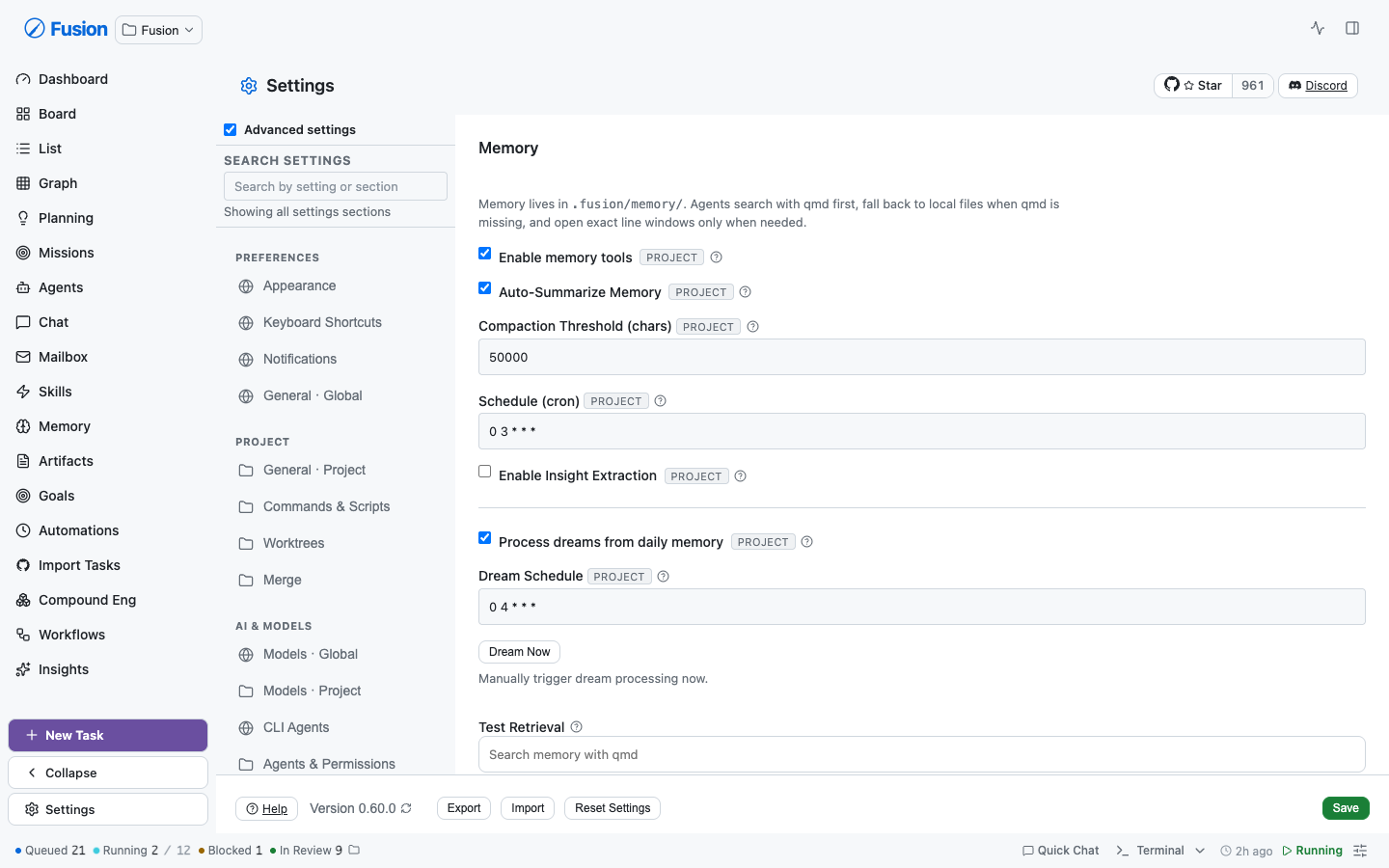 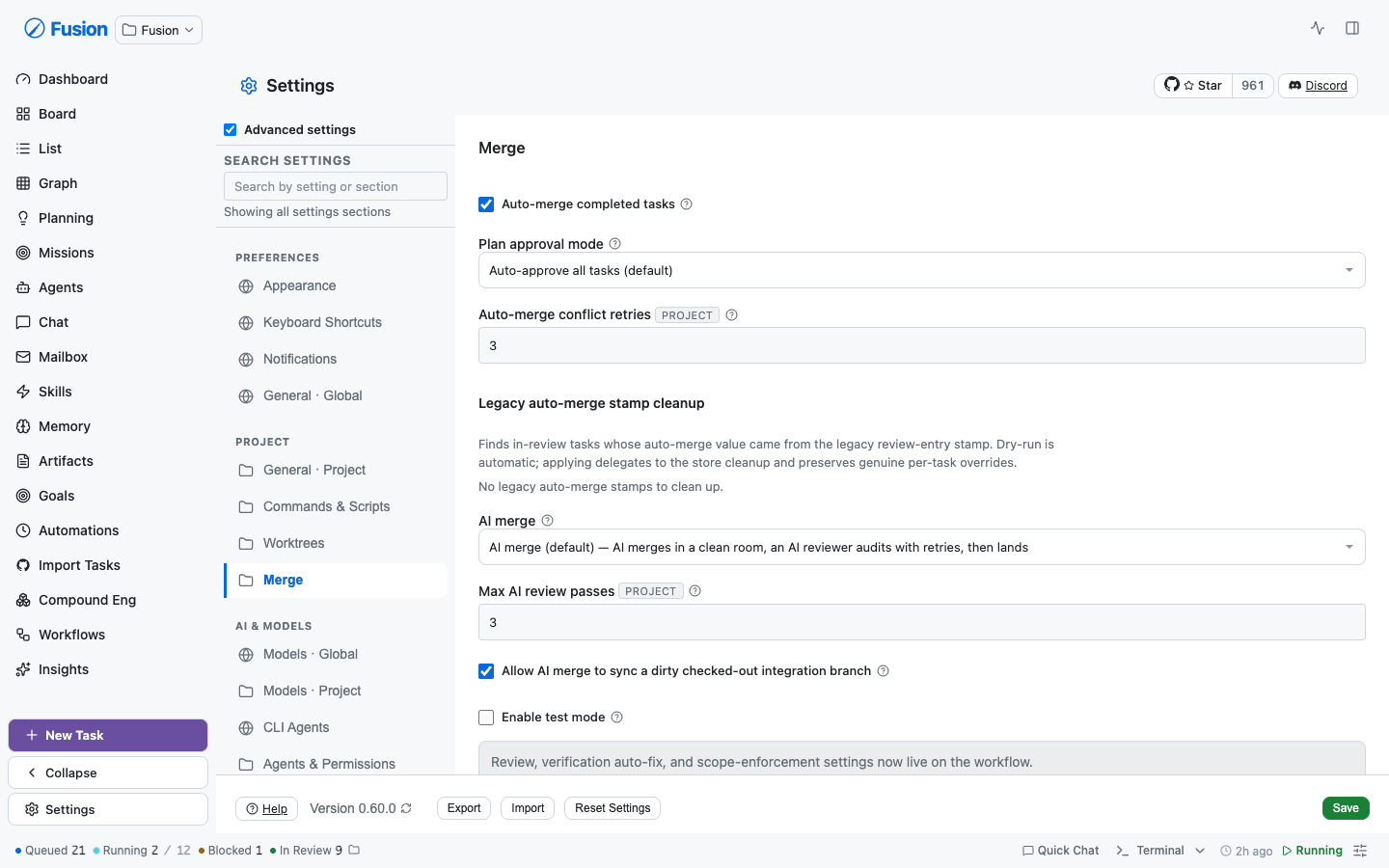 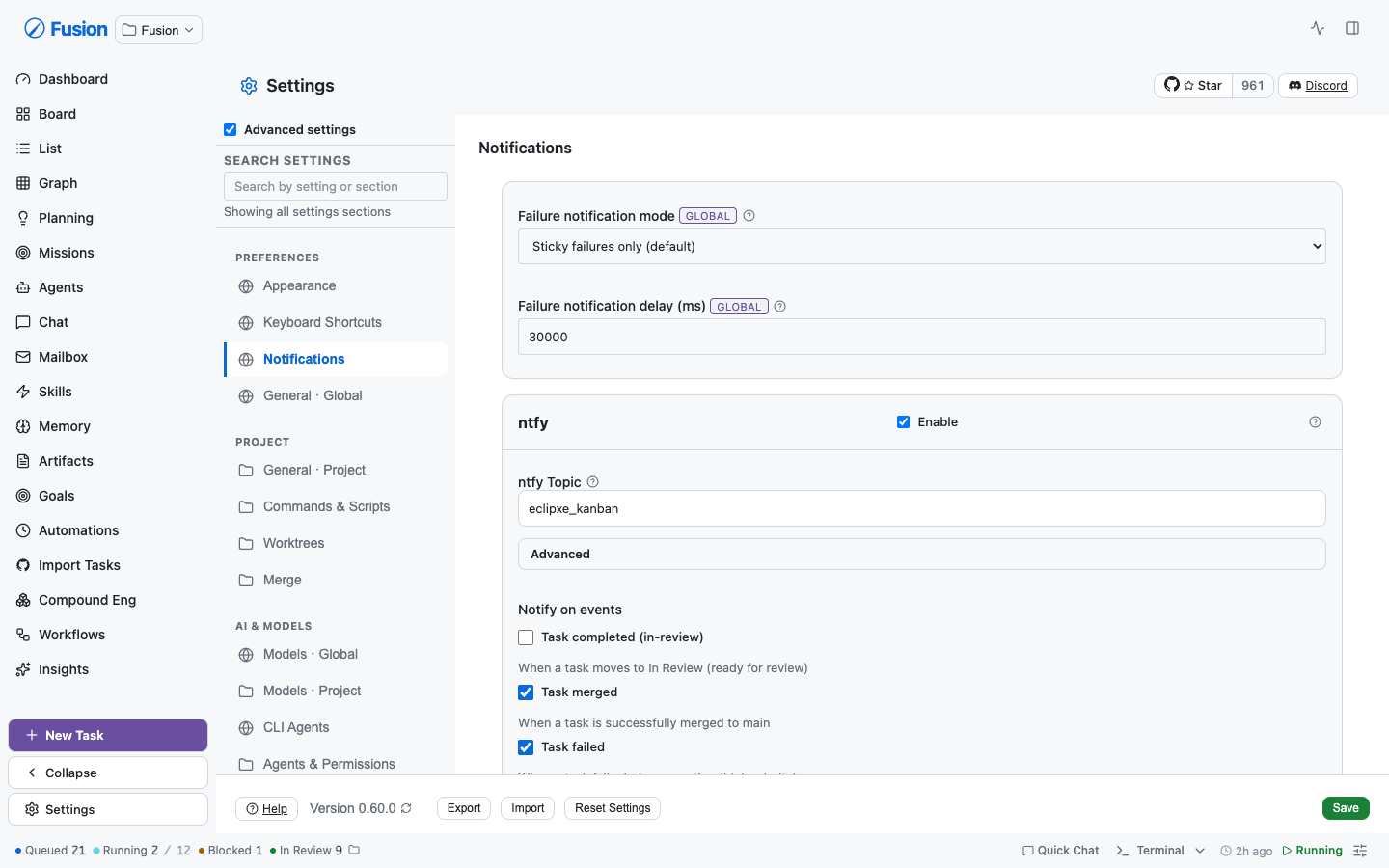 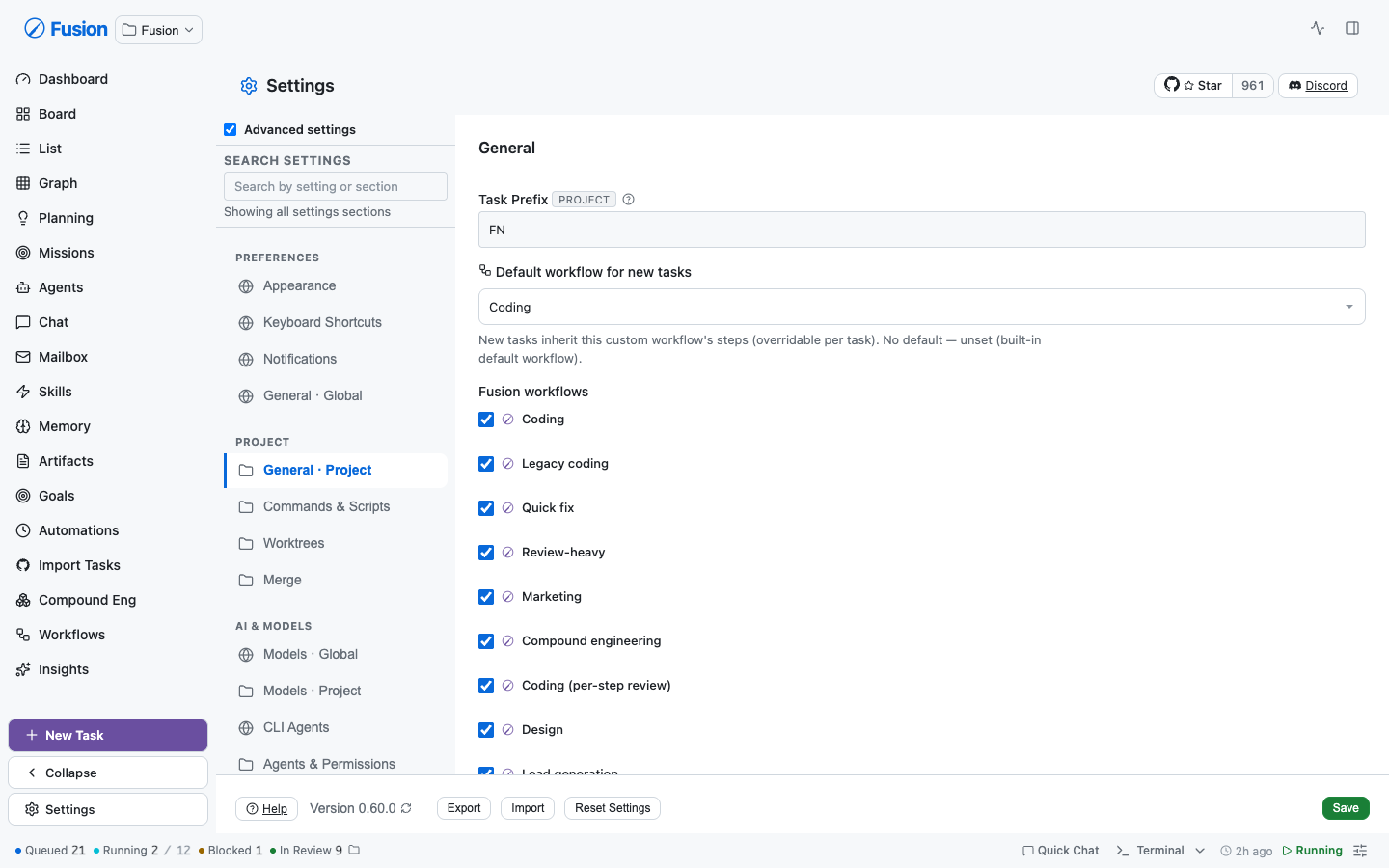 **Global `.form-group` is untouched** — 35 non-settings files style forms with it, so settings migrate *off* it rather than restyle it underneath the rest of the dashboard. ### A real latent bug this surfaced `--font-size-sm` and `--font-size-md` were named by **12 declarations** across AgentDetailView, DockTaskList, SetupWizardModal, and ModelOnboardingModal — but **defined nowhere**. Those rules silently no-op'd and inherited. The command-center token guard is the only thing that catches this class of omission and it doesn't cover those files. The scale is now complete (`2xs · xs · sm · base · md · lg`); `md` is 1.125rem to hold current rendering, since unstyled `h3` already inherits the 1.17em UA default. ## What deliberately did *not* migrate Some rows stay bespoke **on purpose**, not from incompleteness: - **Password fields** (`ntfyAccessToken`, `githubAuthToken`, `gitlabAuthToken`) — `SettingsTextRow` hardcodes `type="text"`, so migrating would have **rendered stored tokens unmasked**. - **Help text with embedded `<code>`/links** — `descriptor.help` is a single string; flattening would drop markup or reword copy. - **`<details>` progressive disclosure** in Merge — a descriptor's help renders unconditionally, so migrating ~10 rows would delete the disclosure and produce a wall of prose. - **Dynamic flag lists** (Experimental) and bespoke editors/CRUD (Prompts, Agents & Permissions, Plugins, KeyboardShortcuts' capture widget) — no settings field name and no i18n key to anchor honestly. ## Data-model ambiguities surfaced (not papered over) These need a human call and are **not** fixed here: - **Five keys are declared in BOTH `DEFAULT_GLOBAL_SETTINGS` and `DEFAULT_PROJECT_SETTINGS`**: `worktrunk`, `testMode`, `gitlabEnabled`, `gitlabAuthToken`, `gitlabAuthTokenType`. No scope badge can be stamped honestly, so those rows are left bespoke. - **`globalMaxConcurrent` lives in the *project* blob** despite its name, its dedicated global endpoint, and the "Global" header it renders under. Its badge is omitted rather than assert a contradiction. - **Two settings were editable from two screens**: `gitlabEnabled` (General + Merge) and `githubTrackingDefaultRepo` (General + Global General). Both are ambiguous-scope and custom widgets, so deduplication is left as follow-up. ## Follow-ups from review **`SettingsTextRow` gained `type`, so the token rows could migrate.** It hardcoded `type="text"`, which is why every secret-bearing row (ntfy access token, GitHub/GitLab tokens, the Cloudflare tunnel token) stayed hand-rolled — migrating would have rendered stored secrets in plain text. `password` rows now default to `autocomplete="off"` so a browser never offers to save an API token, and masking is pinned by tests: a regression there would not throw and would not look wrong in review, the field would simply render the token. That also made them findable. Searching "token" previously matched nothing useful; it now returns 9 settings including *Access token* and *Tunnel token*: **Jump-to-field now reveals collapsed disclosures.** Rows inside a closed `<details>` are in the DOM but invisible, so the jump scrolled to and highlighted a control the operator could not see. The settings most worth searching for are exactly the ones behind "Advanced". **The scope banner is gone.** It claimed one scope for a whole section, which was false wherever a section mixed them — Appearance is a "global" nav entry whose task-presentation toggles are all project-scoped. Per-row badges already say this accurately, so the banner and its dead CSS are removed. **Scheduling is split by scope.** `globalMaxConcurrent` moved to its own `Scheduling · Global` section instead of sitting above the project settings behind an in-section subheading. One section held two authority levels, so "does this affect my other projects?" depended on which subheading you had scrolled past — and a search result landing mid-section shows no subheading at all.  **Text-entry padding is now genuinely uniform.** Settings shipped two input treatments: `.input`/`.select` (6px 10px at 13px) and the global `.form-group input` rule (8px 12px at 14px). Padding depended on whether an ancestor happened to be a `.form-group`, and because `.form-group input` (0,1,1) out-specifies `.input` (0,1,0), naming the standard class on a nested control did nothing. Measured in-browser after the fix: **51 controls across four sections, one appearance, zero outliers.** The same specificity trap was silently re-imposing the uppercase/muted label treatment on migrated rows nested in a `.form-group`; fixed as an invariant rather than per-row, since sections legitimately keep `.form-group` around bespoke content. ## Reconciling with #2147 (please review this call) PR #2147 landed while this branch was open and deliberately moved the two import auto-translate controls **off** `SettingsToggleRow` onto `checkbox-label`, pinning that markup with a test written to survive *"a refactor back onto the primitive"*. Its objection was that the primitive rendered a right-aligned toggle switch clashing with the section's native checkboxes — two idioms in one section. Both halves of that objection are now gone: the primitive renders a native checkbox **before** its label, and every checkbox in that section — including the neighbour the test asserts parity against — renders through it. The idiom split is resolved by migrating all of them rather than de-migrating these two, so the markup assertions now track the primitive. **Every behavioural contract from #2147 is kept and still pinned**, and one was a real bug on this branch: switching auto-translate off wrote `false` where it must write `undefined`, leaving an explicit opt-out in the settings blob instead of staying unset. #2147's curated translate keywords are preserved for the genuine vocabulary gaps ("localize", "localization", "foreign language issues") that appear in no copy. FN-8016's rewritten `taskPopupsBoardListOnly` copy (default now enabled) is adopted into the migrated row and its search entry. Worth noting: #2147's own FNXC says the translate controls were *"effectively unfindable"* because *"settings search only matches curated terms plus advertised i18n keys"* — 25 keywords hand-added days ago. That is precisely the rot this PR's derived index removes. ## Source Control — the duplicate had a cause GitLab settings were split across **three** sections (General: enable + URLs; Merge: auth token + type; Global General: all five at global scope) and GitHub across two. That split is *why* `gitlabEnabled` ended up writable from both General and Merge — two enable toggles for one key, last-save-wins. A `Source Control · Global` / `· Project` pair now owns all 17 keys, adjacent under Integrations, with **one** GitLab disclosure and **one** enable toggle: 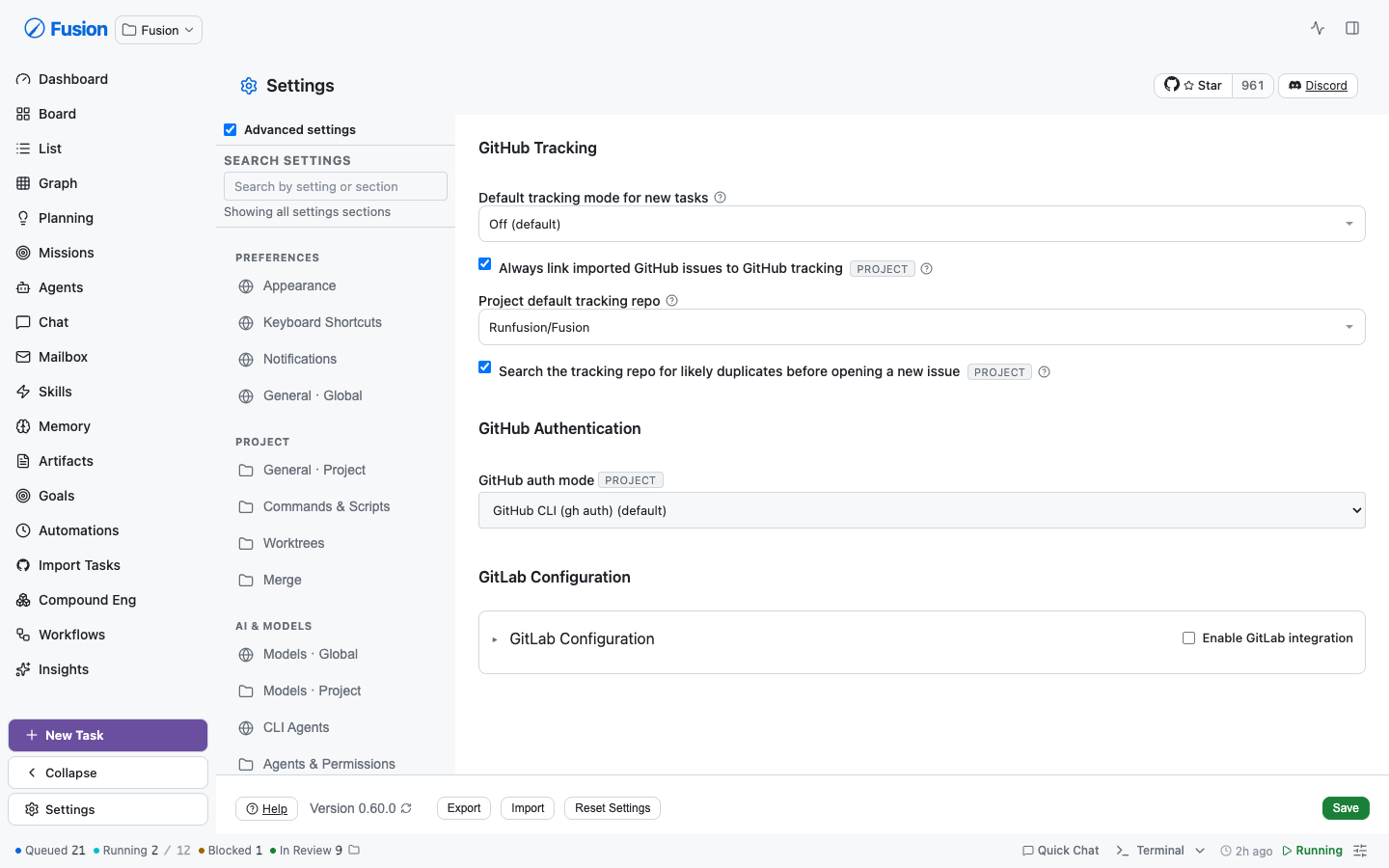 Key ownership moved with them in `section-keys.ts` / `save-split.ts`, so every key has exactly one owner (`section-keys.test.ts` enforces disjointness). **A latent bug surfaced by the move:** nine sites outside the registries hardcode `"global-general"`/`"general"` and silently gate **scope routing** — four in `save-split.ts`, five in `SettingsModal.tsx`. Left stale, global GitLab edits would have been written as project overrides. Also verified against the schema: **all five `gitlab*` keys AND `githubTrackingDefaultRepo`** are declared in both defaults (more than the four originally identified), so those rows carry no scope badge rather than assert a scope the data model can't support. ## Help moved behind a "?" beside every label Rendering every description inline turned dense sections into walls of prose — median help is ~100 chars, some past 400. That pressure is what made Merge invent its own "More details" disclosure, so one section showed two idioms. Measured across sections, Merge's help was **not** unusually long (median 103 vs Appearance's 168, which rendered inline), so the disclosure wasn't earning its keep. The copy is deferred **visually, not removed**: the bubble is always rendered and only fades in, so it stays in the accessibility tree for `aria-describedby`, stays findable with in-page find, and **the search index keeps matching on help text**. Errors are never deferred — a validation message you must hunt for is one you won't see. Only ~24 of 136 `<small>` blocks were actually row help. The rest stay inline on purpose and aren't help: validation errors, live status, empty-state explanations, per-option descriptions inside a multi-select, and copy explaining *why* a control is disabled. `children: ReactNode` (not a string) is what let the `<code>`-bearing and link-bearing rows migrate without rewording your copy — a string API is precisely why they were hand-rolled before. ### Mobile, verified on a 390px viewport 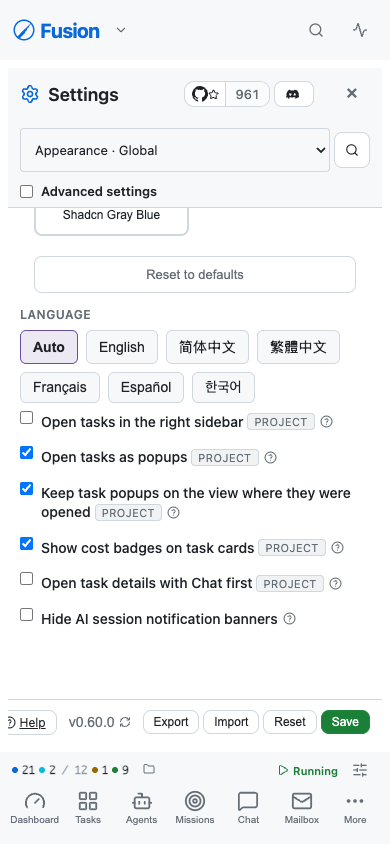 Driving a real phone-sized viewport caught two bugs that neither jsdom nor code review did: - **Bubble rendered off-screen.** The label line reads "Name [scope] ?", so the "?" sits well right of centre; anchored to the trigger, the bubble spanned x=338→658 against a 390px screen — 268px unreachable. `max-width` clamps width but can't help when the *anchor* is near the edge. It now anchors to the row (`inset-inline: 0`): re-measured at x=20→370 inside 390. An earlier comment claimed this behaviour; only the comment existed. - **Two bubbles open at once.** Outside-`pointerdown` dismissal misses a path: `click` fires with **no pointer event** when Enter/Space activates a focused trigger, so a keyboard user opening a second tip left the first open underneath. Tips now broadcast on open and close each other; the regression test asserts the bare-click path specifically. Also verified on touch: tapping outside dismisses, and opening a second tip closes the first — no stranded bubbles. **Checkbox wrapping.** On a 390px viewport a long label ("Keep task popups on the view where they were opened") stranded its checkbox alone on line 1, with the text on lines 2-3 and the badge on line 4. The head was a flex row and the label was a flex ITEM, so once it no longer fit beside the checkbox the whole label wrapped rather than its text. Label + badge + tip now form one group that absorbs the wrapping, leaving the checkbox as the only sibling item; continuation lines align under the first word. Audited every checkbox and radio on all 31 screens at 390px afterwards: **101 controls, all on the first line of their label text.** (The audit's first pass flagged 41 — all false positives from measuring `<label>` elements whose text is a bare text node, i.e. the label box included the checkbox. Re-measuring the text nodes themselves via Range cleared them.) ### Every row, including the ones that stayed bespoke Merge was the last holdout — 18 `<details>` "More details" disclosures plus 4 inline blocks, an idiom it invented and no other section used. All 22 now use the same "?":  Project Models likewise rendered lane help as prose while the global lanes next door already used the tip; its help now hangs on the existing lane label row beside the Override/Inherited badge (the badge is live state and stays visible; the fallback chain behind it is what you open deliberately). **Audited all 31 screens programmatically** (label treatments, control padding, row overflow, leftover banners, horizontal scroll): - **one label treatment on every screen**, one control treatment, zero overflowing rows, zero banners, no horizontal scroll - the copy still rendered inline is deliberately not row help: validation errors, live status, block descriptions, per-option text inside multi-selects, and copy explaining *why* a control is disabled **Known gap:** the three plugin runtime screens (Hermes / OpenClaw / Paperclip) still render inline help. They delegate to `HermesRuntimeCard` / `OpenClawRuntimeCard` / `PaperclipRuntimeCard` — separate card components outside the settings tree — and their copy *is* genuine row help ("Leave blank to resolve hermes from your PATH"). They are advanced-only and were left out of this pass rather than swept in at the end without review. ## Padding and label consistency (measured, not eyeballed) Two idioms were still visible on one screen — Merge rendered "PLAN APPROVAL MODE" in caps directly above "Auto-merge conflict retries" in sentence case. Rows that deliberately stay bespoke inherited the global `.form-group label` treatment. | | Before | After | |---|---|---| | Label treatments | uppercase/muted/11.5px **and** sentence/14px | **70 labels, one treatment** | | Control padding | `6px 10px` **and** `8px 12px` | **81 controls, one treatment** | | Row gaps | 12 / 16 / 20 by adjacency | **0** — every row owns its space | The cause was a specificity trap: `.form-group input` (0,1,1) out-specifies `.input` (0,1,0), so naming the standard class on a nested control did nothing. Fixed settings-scoped; the global `.form-group` is untouched (35 non-settings files depend on it, where uppercase is that context's convention). ## Advanced settings toggle — verified Confirmed in-browser after the regroup: **OFF → 15 sections / 5 groups; ON → 31 sections / 7 groups**, `data-show-advanced` flips, preference persists. The now-empty **Infrastructure and Advanced group headers are correctly hidden** when off — the case the regroup could have broken, since those groups contain only advanced sections. ## Pre-existing failures found (verified NOT caused by this PR) Each verified by running the identical file on the parent commit and diffing the **failure sets**, not just the counts: | Failure | Verified | |---|---| | `SettingsModal.scheduling-merge.test.tsx` — 55 failures | identical set before/after | | `SettingsModal.remote-notifications.test.tsx` — 16 failures | identical set before/after | | `settings-default-descriptions.test.tsx` — `sqliteMigrationNotice`, `postgresMigrationInboxMessageSentAt` | fails on clean tree | | i18n `parity.test.ts` — 12 violations (`settings.general.autoTranslate*`, `taskDetail.plan.*`) | 12 before, 12 after | **This PR adds zero new failures.** Fixed along the way: a stale `AppearanceSection` assertion testing copy FN-7945 deliberately rewrote (failing silently), the ungrammatical "1 matching sections", and `“` rendering literally on screen. ## Verification - `tsc --noEmit -p tsconfig.app.json` → **0 errors** (note: the default `tsconfig.json` only covers `src/` and does **not** typecheck `app/`) - `pnpm test:gate` → **63 passed** - Settings surface → 68 failures, every one a verified subset of the pre-existing baseline, diffed by failure SET not count (this branch incidentally fixes 4) - `pnpm test:gate` 63/63 · lint clean across 83 changed files · `tsc -p tsconfig.app.json` 0 errors - Rebased onto `main`: conflicts with #2147 and FN-8016 resolved - Driven in a real browser at 1440px and 390px: search, jump-to-field, help tips, advanced toggle, and every migrated section - Driven in a real browser: search, jump-to-field, highlight, and every migrated section 🤖 Generated with [Claude Code](https://claude.com/claude-code) <!-- This is an auto-generated comment: release notes by coderabbit.ai --> ## Summary by CodeRabbit * **New Features** * Settings search now indexes individual settings controls, ranks matches, and navigates directly to the exact row with a temporary highlight. * **UI Improvements** * Migrated settings sections to shared row primitives (toggle/select/number/text/textarea) for consistent spacing and touch-friendly controls. * Updated typography to a complete tokenized type scale; added the “?” help tip and tokenized row highlight/error styling. * Navigation and search labels now show clear Global vs Project scope. * **Bug Fixes** * Improved search accuracy using label/help/keywords and fixed settings search counts/pluralization and MCP scope labels. * **Tests** * Added/updated checks to ensure the settings search index stays consistent with rendered rows. <!-- end of auto-generated comment: release notes by coderabbit.ai --> --------- Co-authored-by: Claude Opus 4.8 (1M context) <noreply@anthropic.com>













84 lines
5.1 KiB
TypeScript
84 lines
5.1 KiB
TypeScript
/**
|
|
* Search entries for the Project Models section.
|
|
*
|
|
* FNXC:SettingsSearch 2026-07-15-17:35:
|
|
* One entry per descriptor row the section renders, co-located so a setting and its index entry change in the same edit. Labels and help mirror the section's `t()` calls verbatim: the index matches on the copy operators actually read, so a paraphrase here would make search miss the words on screen.
|
|
* This section is the reason the index was rewritten. Operators searched "summarize" and Project Models did not surface, because the old index was a hand-written keyword list per nav entry; it was patched twice (FN-7907, then again 2026-07-14) and still only covered whatever someone had thought to type. `autoSummarizeTitles` now carries NO keywords on purpose — "Auto-summarize" is in its own label and "summarization" in its help, and both are indexed automatically. Adding "summarize" back as a keyword would restate the label and re-create the list that rotted.
|
|
* Absent by design: the model-lane pickers, the Chat default target picker, preset CRUD and its per-size grid, and the workflow lane rows. They are bespoke widgets, not descriptor rows — there is no `data-settings-key` anchor for a result to jump to.
|
|
*/
|
|
import type { SettingsSearchEntry } from "../search/types";
|
|
|
|
export const projectModelsSearchEntries: SettingsSearchEntry[] = [
|
|
{
|
|
sectionId: "project-models",
|
|
key: "tokenCap",
|
|
labelKey: "settings.projectModels.tokenCap",
|
|
labelFallback: "Token Cap",
|
|
helpKey: "settings.projectModels.automaticallyCompactContextWhenApproachingThisTokenCount",
|
|
helpFallback:
|
|
"Automatically compact context when approaching this token count. Leave empty for no cap (compact only on overflow errors). Set a number to proactively compact when reaching this token count. No default — unset (no cap).",
|
|
keywords: ["context window", "limit", "budget"],
|
|
},
|
|
{
|
|
sectionId: "project-models",
|
|
key: "chatNewSessionMode",
|
|
labelKey: "settings.projectModels.chatNewSessionMode",
|
|
labelFallback: "New Chat behavior",
|
|
helpKey: "settings.projectModels.chatNewSessionModeHelp",
|
|
helpFallback:
|
|
"Prompt mode opens New Chat with this default preselected. Always-default mode skips the dialog when the configured default is complete.",
|
|
keywords: ["direct chat", "skip dialog"],
|
|
},
|
|
{
|
|
sectionId: "project-models",
|
|
key: "autoSelectModelPreset",
|
|
labelKey: "settings.projectModels.autoSelectPresetBasedOnTaskSize",
|
|
labelFallback: " Auto-select preset based on task size ",
|
|
helpKey: "settings.projectModels.autoSelectModelPresetHint",
|
|
helpFallback: "Default: disabled.",
|
|
/*
|
|
FNXC:SettingsSearch 2026-07-15-17:35:
|
|
The help is just "Default: disabled.", so this row's only indexable copy is its label. The sizes it selects between (S/M/L) live in the grid below, which is bespoke and unindexed, hence the size keywords here.
|
|
*/
|
|
keywords: ["small", "medium", "large", "S M L"],
|
|
},
|
|
{
|
|
sectionId: "project-models",
|
|
key: "autoSummarizeTitles",
|
|
labelKey: "settings.projectModels.autoSummarizeLongDescriptionsAsTitles",
|
|
labelFallback: " Auto-summarize long descriptions as titles ",
|
|
helpKey: "settings.projectModels.whenEnabledTasksCreatedWithoutATitleBut",
|
|
helpFallback:
|
|
" When enabled, tasks created without a title but with descriptions over 200 characters will automatically get an AI-generated title (max 60 characters). The same model is also used to generate fallback merge commit message bodies when the branch's commit log is empty (e.g. squash merges with no unique commits), and GitHub tracking issue titles when a tracked task has no title yet. Default: disabled. ",
|
|
},
|
|
{
|
|
sectionId: "project-models",
|
|
key: "useAiMergeCommitSummary",
|
|
labelKey: "settings.projectModels.aIMergeCommitSummaries",
|
|
labelFallback: " AI merge commit summaries ",
|
|
helpKey: "settings.projectModels.whenEnabledMergeCommitMessagesIncludeAnAI",
|
|
helpFallback:
|
|
" When enabled, merge commit messages include an AI-generated subject plus body summary (narrative + bullets + diff-stat) instead of just listing step commit subjects. Uses the title summarization model. Default: enabled. ",
|
|
},
|
|
{
|
|
sectionId: "project-models",
|
|
key: "prTitlePromptInstructions",
|
|
labelKey: "settings.projectModels.prTitlePromptInstructions",
|
|
labelFallback: "PR title prompt guidance",
|
|
helpKey: "settings.projectModels.prTitlePromptInstructionsHelp",
|
|
helpFallback:
|
|
"Guides the AI-generated Create PR title. Leave blank to use the default PR metadata prompt. No default — unset.",
|
|
keywords: ["pull request", "conventional commit"],
|
|
},
|
|
{
|
|
sectionId: "project-models",
|
|
key: "prDescriptionPromptInstructions",
|
|
labelKey: "settings.projectModels.prDescriptionPromptInstructions",
|
|
labelFallback: "PR description prompt guidance",
|
|
helpKey: "settings.projectModels.prDescriptionPromptInstructionsHelp",
|
|
helpFallback:
|
|
"Guides the AI-generated Create PR summary, changes, and testing sections. Leave blank to use the default PR metadata prompt. No default — unset.",
|
|
keywords: ["pull request", "body"],
|
|
},
|
|
];
|